Tuesday, April 10, 2012

Shepard State Park, Mississippi


Sunset view from our campground site :).


Shepard State Park is nestled in the heart of Singing River (Pascagoula River) country, where legend has it that members of the Pascagoula Indian nation linked hands and walked into the Pascagoula River rather than be taken captive by hostile Indian tribes. The mournful death chant they sang as they walked earned the Pascagoula River the nickname "Singing River." Tales of the heroic exploits of French and Spanish settlers and romantic legends of the Pascagoula and Biloxi Indians are standard fare in the scenic coastal area surrounding Shepard State Park. (mississippistatepark.com)
Pascagoula River at campground


Sunday, April 8, 2012

Davis Bayou Area of the Gulf Islands National Seashore.


We arrived in Mississippi and visited the Davis Bayou Area of the Gulf Islands National Seashore.
This area has an informative visitor's center named The William M. Colmer Visitor Center is now open daily from 8:30 a.m. - 4:30 p.m. except for Thanksgiving, Christmas and New Years Day. Visitors can view a park orientation film and exhibits, and purchase items at the book store. I purchased a book on seashell identification and an interpretive guide on the Gulf Island National Seashore. (nps.gov)

We saw this cute little raccoon walking across the parking lot and I just had to snap a picture :).


We met a nice family that were spending the day fishing on the pier. They caught some big Blue Crabs.

Saturday, April 7, 2012

Parting Pictures of Louisianna

Since we will now be leaving Louisiana and moving toward Mississippi tomorrow. We thought it would be nice to post some pics of the waterway right behind our campsite at Lake Fausse Pointe State Park.


If you look closely to the right in this pic you will see the deck some of the sites have where people can tie up their boat or set a couple of lawn chairs on and fish in the waterway.


Here is the waterway that was at the back of a campsite.


This state park has tons of wild life everywhere you look including these two large alligators that passed by our campsite every night right before the sunset.


They had these signs posted in the campground. We had to laugh when we read them and wondered who in their right mind would get close enough to one of these alligators to feed them!


We looked off the ranger's porch and saw all these alligators piled one on top of the other. Watch where you step around here!


This cabin is on the road to the state park. We got a kick out of the sign and took the pic.

Thursday, April 5, 2012

Avery Island, La, Botanical Treasures

Here are some more pics of our visit to Avery Island, enjoy.


E. A. McIlhenny, or “Mr. Ned” as he was affectionately known, founded a bird colony in the 1890s — later called Bird City — after plume hunters slaughtered egrets by the thousands for feathers to make fashionable ladies’ hats. Mr. Ned gathered up eight young egrets, raised them in captivity on the Island, and released them in the fall to migrate across the Gulf of Mexico. The following spring, the birds returned to the Island with others of their species — a migration that continues to this day, as thousands of snowy white egrets and other water birds return to Bird City. This vast, protected rookery owes its existence to Mr. Ned.


Botanical Treasures

Mr. Ned also prized rare plants, and he enhanced the Island’s natural landscape with numerous varieties of azaleas, Japanese camellias, Egyptian papyrus and other botanical treasures. When oil was discovered on the Island in 1942, he made sure that production crews bypassed live oak trees, buried pipelines (or painted them green), and took additional steps to preserve the Island’s pristine beauty and ensure its continuing role as a wildlife refuge. (Tabasco.com)


Friday, March 30, 2012

Buddha Statue at Avery Island, LA

Avery Island in Louisiana is home to a beautiful statue of a Buddha that is housed in a glass temple that looks over a lovely Asian themed garden.

This is the path that you walk to get to the Buddha.


This Buddha originally lived in the Shonfa Temple northeast of Peking and was commissioned by Emperor Hui-Tsung between 1101 and 1125.


According to tradition, in the 1920s a Chinese warlord sent a roughly 900-year-old statue of Buddha to America, where it sat unclaimed for many years in a New York City warehouse. In 1936, two friends of E. A. ("Ned") McIlhenny  purchased the statue and sent it to him by rail as a surprise. Ned responded by designing an Asian-influenced garden setting for the sacred statue. He constructed a long forest pool, an arched stone bridge, and glass-enclosed temple. He built up seven "hills of knowledge" that surround the Buddha and covered them with azaleas, sasanqua, camellias, and bamboos.
The glass is very scratched up so it is hard to get a clear pic of the statue.

Today the Buddha statue serves as a centerpiece of Jungle Gardens and greets thousands of visitors annually.

From tobasco.com:

Saturday, March 24, 2012

The Tabasco Factory Tour

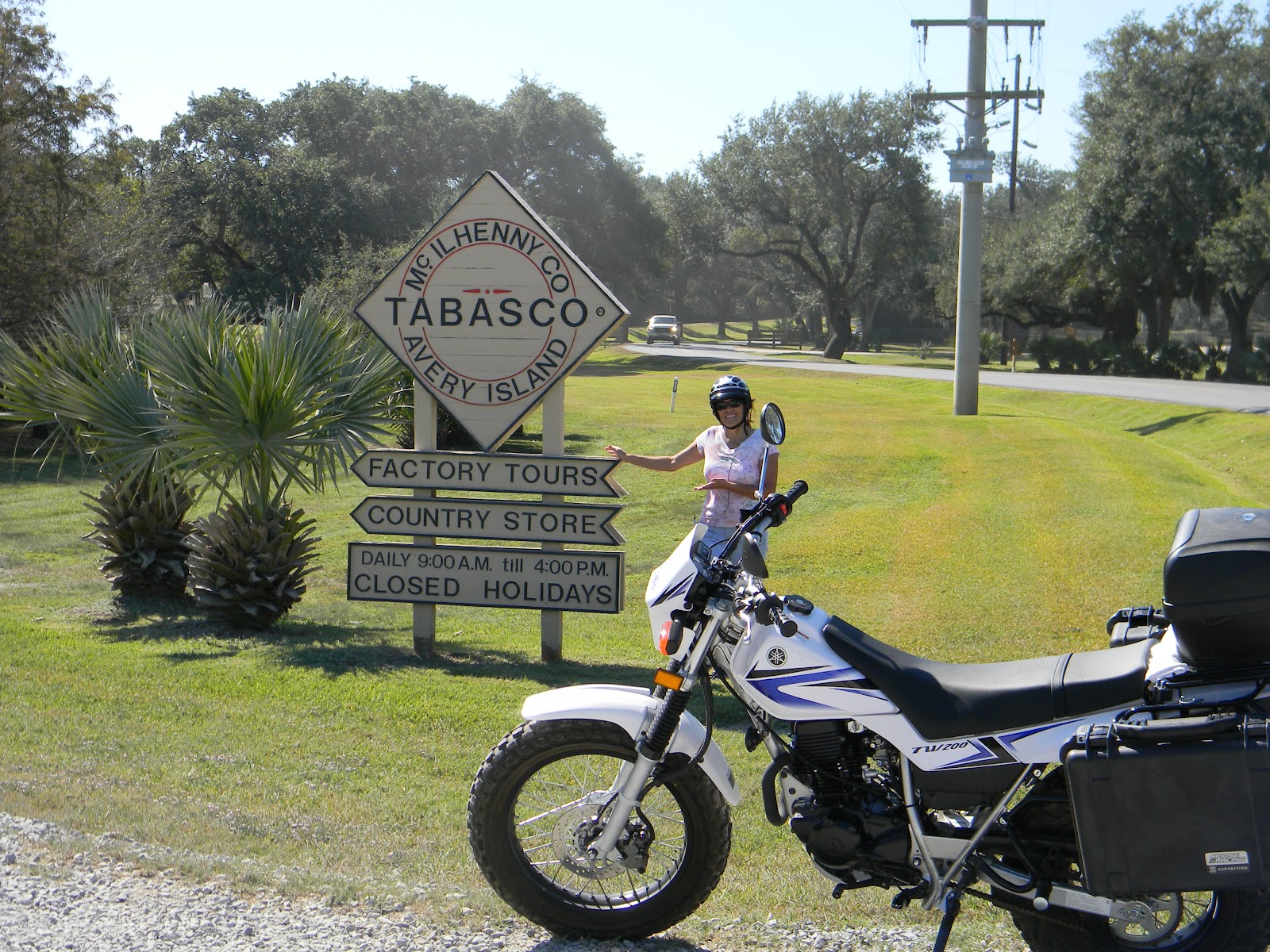
We went to the Tabasco Factory Tour on Avery Island, La.

There was a short film about the history and products, then a tour of the factory. When we were there that day's hot sauce was going to Germany. They explained how it is made in much the same way, aged in white oak barrels sealed with salt from the island's salt mine.

Then we spent time in the Country Store that had everything you could think of to buy related to Tabasco.


Friday, March 23, 2012

Live Oak Trees of Avery Island, La

Today's post is dedicated to the beautiful Live Oak Trees on Avery Island. These trees are absolutely breath taking and hard to describe in words or capture in pictures. They are huge and strong. The Spanish Moss that hangs from their branches give them an elegant appearance.
Each tree has a different appearance because of the way the branches expand, twist, and reach outward toward the ground in a horizontal manner and then turn back up to the sky. These trees are everywhere in the south but you never get tired of the awe inspiring feelings each one of them produce when you view them.


Their branches twist and turn every which way and it feels like they are going to reach out and scoop you up...just like in the Wizard of Oz movie. It is hard to determine if they are gorgeous or scary.


The Spanish Moss that hangs from the branches.
Spanish moss has been used for various purposes, including building insulation, mulch, packing material, mattress stuffing, and fiber. In the early 1900s it was used commercially in the padding of car seats.
The legend of how Spanish Moss came to be:
As the story goes; there was once a traveler who came with his Spanish fiancĂ©e in the 1700s to start a plantation near the city of Charleston, SC. She was a beautiful bride-to-be with long flowing raven hair. As the couple was walking over the plantation sight[sic] near the forest, and making plans for their future, they were suddenly attacked by a band of  Cherokee who were not happy to share the land of their forefathers with strangers. As a final warning to stay away from the Cherokee nation, they cut off the long dark hair of the bride-to-be and threw it up in an old Live Oak Tree. As the people came back day after day and week after week, they began to notice the hair had shriveled and turned grey and had begun spreading from tree to tree. Over the years the moss spread from South Carolina to Georgia and Florida. To this day, if one stands under a live oak tree, one will see the moss jump from tree to tree and defend itself with a large army of insects.
http://en.wikipedia.org/wiki/Spanish_moss